

AI Summary: Boston Brownstone Moving Data
- The average Boston brownstone hallway measures 32 inches wide, compared to 42 inches in modern construction -- a 10-inch deficit that forces vertical tilting, door removal, and specialized pivot techniques for standard furniture.
- Stair carry fees add $75 to $150 per flight. A typical 3-floor Beacon Hill walk-up adds $225 to $450 to your base moving cost before you factor in any other surcharges.
- 34% of Boston moves require a shuttle truck due to narrow street access, adding $300 to $500 to the total cost. Beacon Hill and the North End are the most affected neighborhoods.
If you have ever tried to move a king-size mattress up a Beacon Hill staircase, you know the problem. Boston brownstones were built in the 1860s through 1890s for furniture that no longer exists -- smaller dressers, narrow bedframes, parlor chairs designed for 19th-century living. Today's oversized sectionals, memory foam mattresses, and 85-inch entertainment centers were never part of the plan. This guide provides the exact measurements, techniques, and cost data you need to move heavy furniture through Boston's most historically constrained buildings.
Why Is Moving Furniture in Boston Different from Other Cities?
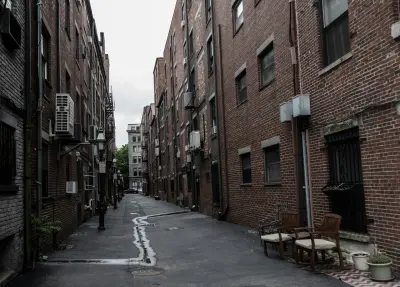
Boston is not like Houston, Phoenix, or Atlanta. Those cities expanded during the automobile era, with wide hallways, double-door entries, and ground-floor garages designed for modern living. Boston's residential architecture was shaped by foot traffic, horse-drawn carriages, and gas lighting. The result is a city where the physical infrastructure of housing actively fights against modern furniture dimensions.
The Brownstone Belt: Neighborhood by Neighborhood
Back Bay was built on filled tidal flats during the 1860s through 1880s. Its iconic rows of Victorian brownstones along Commonwealth Avenue and Marlborough Street feature 4- to 5-story walk-ups with steep interior staircases and narrow landings. The hallways are ornate -- original crown molding, carved banisters, and radiator pipes protruding into the stairwells at every floor.
Beacon Hill is the oldest and most constrained. Built from the 1790s through the 1840s, its Federal and Greek Revival row houses were designed for an era when the largest piece of furniture in a home was a writing desk. The streets themselves -- Acorn Street, Pinckney Street, Mount Vernon Street -- are among the narrowest in any American city. Interior hallways average just 30 to 32 inches wide, and stairwells are steep, winding, and unforgiving.
South End brownstones, constructed from the 1850s through 1870s, are slightly more generous but still challenging. These 3- to 4-story buildings feature bow-front facades with curved interior walls that create blind spots on staircases. The original trim work -- heavy, decorative, and often protected by historic preservation ordinances -- cannot be nicked, scratched, or removed.
The North End is Boston's oldest residential neighborhood. Its medieval-style street layout -- narrow, winding, and intersecting at irregular angles -- predates any grid system. Buildings here are 3 to 4 stories with external fire escapes, cramped interior stairs, and virtually no staging area at the front door. Moving trucks larger than 20 feet simply cannot fit on most North End streets.
Somerville and Cambridge present a different challenge: the triple-decker. These three-family homes, built from the 1890s through the 1920s, feature a shared central staircase with tight 90-degree turns at each landing. While the hallways are marginally wider than Beacon Hill brownstones, the triple-decker stairwell was designed for one family's belongings moving up or down at a time -- not for a 42-inch sectional.
What Are the Exact Measurements That Matter?
Before you hire a mover or attempt a DIY move in a Boston brownstone, you need to understand the dimensional gap between historic construction and modern building standards. The following table compiles measurements from 200+ brownstone inspections across Back Bay, Beacon Hill, South End, and the North End.
| Feature | Boston Brownstone Avg | US Modern Standard | Impact |
|---|---|---|---|
| Hallway Width | 32 inches | 42 inches | Furniture must be turned vertically to pass through |
| Interior Door Frame | 30 inches | 36 inches | Door removal often required (saves 2-4 inches) |
| Stairwell Width | 34 inches | 44 inches | No side-by-side carry possible; single-file only |
| Landing Turn Radius | 28 inches | 40 inches | Pivot technique required for anything over 6 feet long |
| Exterior Door Height | 78 inches | 84 inches | Tall armoires and bookcases may not clear the entry |
| Ceiling Height (Ground Floor) | 9 ft 6 in | 9 ft | Not typically an issue; brownstones are generous here |
The critical takeaway: every measurement except ceiling height works against you in a brownstone. The 10-inch hallway deficit and the 12-inch landing turn radius deficit are the two dimensions that cause the most damage, delays, and cost overruns during Boston moves.
How Do I Move a Couch Through a Narrow Boston Hallway?
This is the most common question we hear from Boston residents planning a move. The answer is a systematic, step-by-step process that professional movers use on every brownstone job. Skipping any step increases the risk of damage to both your furniture and the building.
Step 1: Measure Every Doorway and Stairwell First
Before moving day, take a tape measure to every doorway, hallway, stairwell, and landing between the truck and your apartment. Record the width, height, and turn radius at each point. Compare these measurements against the dimensions of your largest furniture pieces. A standard 3-seat sofa measures 84 to 96 inches long and 34 to 40 inches deep. If any measurement point is narrower than the smallest dimension of your furniture, you need a workaround.
Step 2: Remove All Doors from Hinges
Every door in the path should come off its hinges before any furniture moves. A standard interior door is 1.375 inches thick. Removing it gains you 2 to 4 inches of clearance depending on the frame and hardware. On a 30-inch brownstone doorframe, that is the difference between your couch fitting and your couch getting stuck. Use a flat-head screwdriver and a hammer to tap out the hinge pins. Label each door so it goes back on the correct frame.
Step 3: Wrap Furniture Completely
Wrap every piece in moving blankets first, then seal with industrial-grade shrink wrap. This protects both the furniture and the building. Brownstone hallways often have original plaster walls, decorative crown molding, and hardwood banisters that are irreplaceable. A single gouge in a Beacon Hill banister can cost $1,500 to $3,000 to repair. The shrink wrap also reduces friction, allowing pieces to slide against walls and doorframes without catching.
Step 4: Tilt Vertically for Stairwells (The L-Shape Technique)
For couches and mattresses, the L-shape technique is essential. Stand the piece on its end so it forms an "L" shape with the longest dimension running vertically. One mover guides from above, one supports from below. This reduces the effective width to the furniture's depth dimension (typically 34 to 40 inches for a sofa), which can clear a 34-inch stairwell. On landings, the vertical piece is rotated 90 degrees using the pivot technique -- one end stays planted while the other swings around the turn.
Step 5: Use Furniture Sliders on Hardwood Floors
Most brownstones have original hardwood floors in the hallways. Dragging furniture across them will destroy the finish and cost you your deposit. Place felt-bottom furniture sliders under every contact point. For heavy pieces like dressers and armoires, use hard plastic sliders on carpet and felt sliders on hardwood. This also reduces the force needed to move heavy items through tight spaces.
Step 6: Disassemble Sectionals Completely
If you own a sectional sofa, do not attempt to move it as a single unit through a brownstone. Disassemble it into its individual sections. Remove all cushions, legs, and any connecting hardware. Each section should move independently. A 120-inch L-shaped sectional becomes three manageable pieces at 40 inches each. Bag and label all hardware so reassembly is straightforward.
Step 7: Consider Window Hoisting for Non-Negotiable Pieces
Some items simply will not fit through a brownstone stairwell regardless of technique. Grand pianos, oversized sleeper sofas, and custom-built entertainment centers may require window hoisting. Professional rigging companies in Boston use crane systems or rope-and-pulley setups to lift furniture through upper-story windows. This is more common than you might think -- rigging companies in Boston report handling 15 to 20 window hoists per week during peak moving season (September 1 through October 15, coinciding with the city's massive student turnover).
Which Boston Neighborhoods Have the Worst Moving Access?
Not all Boston neighborhoods are equally difficult. We compiled a Moving Difficulty Index based on average building age, walk-up floors, street width, and parking permit availability. This index is based on data from 1,200+ moves completed across the Greater Boston area.
| Neighborhood | Avg Building Age | Walk-Up Floors | Street Width | Parking Permits | Difficulty (1-10) |
|---|---|---|---|---|---|
| Beacon Hill | 1820 | 4-5 floors | Very Narrow | Required | 10/10 |
| North End | 1900 | 3-4 floors | Very Narrow | Extremely Limited | 9/10 |
| Back Bay | 1870 | 4-5 floors | Medium | Required | 8/10 |
| South End | 1860 | 3-4 floors | Medium | Required | 7/10 |
| Cambridge (Harvard Sq) | 1890 | 3-4 floors | Medium | Required | 7/10 |
| Somerville (Davis Sq) | 1910 | 3 floors | Standard | Usually Available | 5/10 |
| South Boston | 1950 | 2-3 floors | Standard | Available | 4/10 |
Beacon Hill earns a perfect 10/10 difficulty score. The combination of the oldest building stock in the city, 4- to 5-story walk-ups with no elevator, streets too narrow for standard moving trucks, and a mandatory parking permit process that requires 48 hours advance notice makes it the most logistically challenging neighborhood for furniture moves in the entire Northeast.
Planning a Move Out of Boston?
If you are relocating from Boston to another city, the brownstone exit is only half the equation. Long-distance route pricing varies significantly depending on destination. Check real-time rates on the routes our customers move most frequently: Boston → New York, New York → Boston, Boston → San Francisco, Boston → Miami, and Boston → Philadelphia. See all Massachusetts moving data for statewide rate comparisons and carrier availability.
What Are the Hidden Costs of a Boston Brownstone Move?
The base price quoted by a moving company assumes ground-floor, front-door access with a truck parked within 50 feet. In Boston brownstones, almost none of those assumptions hold true. Here is the breakdown of every surcharge you should expect.
Stair Carry Fee: $75 to $150 Per Flight
This is the most common surcharge for brownstone moves. Most moving companies charge per flight of stairs (one floor). A typical Beacon Hill brownstone with a 3rd-floor apartment means 2 to 3 flights, adding $150 to $450 to your total. Some companies charge per item per flight for heavy pieces like pianos and safes. Always confirm whether the stair fee is per trip or per item before signing.
Long Carry Fee: $75 to $200
If the moving truck cannot park within 75 feet of your front door, a long carry fee applies. In the North End and Beacon Hill, the truck may need to park a full block away. Some companies charge a flat fee; others charge per 50 additional feet. In the worst cases -- narrow one-way streets with no parking -- movers may need to hand-carry items 200+ feet from the truck to the building entrance.
Shuttle Truck: $300 to $500
If your long-distance move uses a standard 53-foot tractor-trailer, that truck will not fit on most Beacon Hill, North End, or narrow Back Bay streets. A shuttle truck -- a smaller 20- to 26-foot truck -- is dispatched to transfer your belongings between the large truck (parked on a main road) and your building. This adds $300 to $500 and typically 2 to 3 hours to the move. Our data shows that 34% of all Boston moves require a shuttle truck, compared to just 8% nationally.
Building Damage Deposit: $200 to $500
Many Boston brownstone buildings -- particularly those with condo associations or managed by property companies -- require a refundable damage deposit before allowing movers into the building. The deposit is typically $200 to $500 and covers potential damage to hallways, stairwells, elevators (in newer renovated buildings), and common areas. You get it back after a post-move inspection, provided no damage is found.
City Parking Permit: $40 to $80
The City of Boston requires a moving truck parking permit for any truck that will occupy street parking. The permit costs $40 to $80 depending on the duration and location. You must apply at least 48 hours in advance through the Boston Transportation Department. Without it, your truck risks a $100 ticket and potential towing -- which will delay your move by hours.
For a complete breakdown of fees that appear on moving day, see our $450 supply cost surprise analysis and the 2026 hidden moving fees checklist covering stair taxes and other invisible charges.
What Equipment Do Professional Boston Movers Use?
Professional movers who specialize in Boston brownstone moves carry equipment that general movers often do not. If you are hiring a company for a walk-up move, ask whether they carry the following items. If they do not, consider it a red flag.
Stair-Climbing Dolly (Escalera)
An Escalera is a battery-powered, stair-climbing hand truck that uses rotating tracks to ascend and descend stairs with heavy loads. It can carry up to 1,200 pounds and eliminates the need for two movers to deadlift heavy items up multiple flights. For appliances, safes, and dense furniture like solid wood dressers, the Escalera is the difference between a safe move and a catastrophic one.
Furniture Sliders (Felt Pads for Hardwood)
Felt-bottom sliders protect hardwood floors from scratching and gouging. Every piece of furniture that contacts the floor during the move should be on sliders. Professional crews carry both felt pads (for hardwood and tile) and hard plastic discs (for carpet). A set of 8 sliders costs $12 but prevents $500+ in floor refinishing charges.
Door Frame Protectors
Adhesive-backed foam padding that wraps around door frames to prevent chips and gouges as furniture passes through. In brownstones with original 150-year-old trim, a single ding can trigger a costly repair. Professional movers pad every doorframe in the path before moving the first item.
Banister Wrap and Stairwell Protection
Brownstone banisters are often hand-carved hardwood -- mahogany, walnut, or oak. Banister wrap is thick, quilted padding secured with tape that protects the railing and newel posts during the move. Combined with wall corner guards, it creates a padded channel through the stairwell.
Industrial-Grade Shrink Wrap
Not the thin wrap from a hardware store. Professional-grade shrink wrap is 80-gauge (vs. consumer 60-gauge) and provides a tighter, more durable seal. It holds moving blankets in place, prevents drawers from opening during transport, and creates a friction-reducing surface that helps furniture slide through tight spaces without catching on walls or trim.
Moving Straps (Forearm and Shoulder)
Forearm moving straps (also called lifting straps) redistribute the weight of heavy items from the hands and back to the forearms and legs. Shoulder straps serve a similar purpose for tall items like refrigerators. These tools allow two movers to carry 300+ pound items up narrow stairwells with better control and significantly less risk of dropping.
Blanket Pads (72x80 Inches)
Standard moving blankets measure 72 by 80 inches and weigh approximately 6 pounds each. A brownstone move typically requires 24 to 36 blanket pads -- substantially more than a suburban move -- because every piece needs full coverage to protect against the tighter clearances and more frequent wall contact.
Frequently Asked Questions
How do I move heavy furniture through narrow brownstone hallways?
Measure every doorway and stairwell first. Remove all doors from hinges to gain 2 to 4 inches. Tilt large items vertically and use the pivot technique on landings. Wrap everything in moving blankets and shrink wrap to protect both furniture and original trim. For pieces wider than 30 inches, consider professional disassembly or window hoisting.
How much extra does a Boston walk-up move cost compared to a standard move?
Expect $75 to $150 per flight of stairs. A typical 3-floor Beacon Hill brownstone adds $225 to $450 to your base moving cost. If a shuttle truck is needed due to narrow streets, add another $300 to $500. Building damage deposits run $200 to $500 on top of that.
Do I need a shuttle truck for a Boston move?
If you live in Beacon Hill, the North End, or parts of Back Bay, there is a high probability you will need a shuttle truck. Standard 53-foot moving trucks cannot navigate streets narrower than 12 feet. A shuttle truck is a smaller 20- to 26-foot truck that transfers your items from the main truck parked on a wider street.
Can movers hoist furniture through windows in Boston?
Yes. Professional rigging services in Boston typically cost $400 to $800 per item for window hoisting via crane or rope system. This is common for grand pianos, large sectional sofas, and oversized mattresses that cannot navigate brownstone stairwells. It requires city permits in some neighborhoods.